Lessons learnt from my first Remote Workshop
Originally published on Medium on June 15, 2020.
Week Notes S3E0 Lessons learnt from my first Remote Workshop
I ran my first remote workshop in March, pulling together teams from the UK, Kenya, Middle East and India to articulate their requirements for taking a local solution global.
Overall, I’m happy with the outcomes. We got what we needed out of the session. But it could have gone smoother, so I wanted to capture some of my thoughts for next time.
The Technology
I had a specific goal for this workshop: To jointly develop “A roadmap of functionality that will enable [Local Solution] to be used on client projects in Kenya and the Middle East” which I wanted to achieve by taking the group through a specific journey.
In the run up to the session I demoed a number of online tools for the first time that support remote workshopping including https://miro.com/ and https://mural.co/ , these are great tools with great ideas! That being said, the templates whilst numerous don’t cover all use cases and it takes time to become comfortable with a tool to use it in anger during a session.
So I went back to thinking how I’d run this session in real life and translated that into digital form via slides. It may be a tad ‘boring’ compared to the more creative options out there, but ‘if it works, don’t break it’. The latter part of my session was used to translate user focussed narrative into more abstract features; for which I used Microsoft Whiteboard side-by-side with the slides using a split screen to steer the conversation (or at least try to).
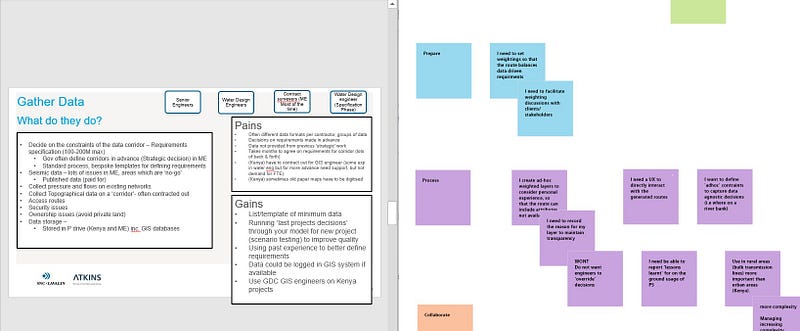
The actual work of presenting the session was on Microsoft Teams, which held up perfectly. I know other products (notably Zoom) have more features to support these sorts of sessions such as ‘breakout rooms’ but Teams didn’t let me down collaborating with a truly global audience.
I also note that Microsoft Whiteboard does include ‘Templates’ similar to Miro or Mural, however they are still in BETA stage and not comprehensive for all use cases yet.
Outcome: I felt from a technology perspective this setup worked well and I’d use it again. I hope to use the Microsoft Templates more as they mature as a feature.
The Structure
I put a lot of thought into structuring the session, both in terms of the outcomes and how I thought we’d get there. On the whole it went ‘OK’ in terms of getting the outcomes I was after, but a few thoughts:
- Although I thought I’d been upfront before the session on the outcomes, participants still turned up with different expectations. I should have reinforced that more, maybe by sharing the below slide in advance
- I hadn’t thought enough about how participants want to communicate in detail. At times I’d structured things so that topics A and B were to be discussed/captured separately during the session whilst in reality participants wanted to talk about A & B together. If we were in-person this wouldn’t be an issue, but when you’re working within the bounds of pre-prepared content/structure it can quickly derail your ‘Game plan’.
- I’ll talk more about facilitation in a moment, but regarding structure it’s really hard to have the headspace to restructure on-the-go whilst keeping everyone together on the journey to achieving your set goal. You either need to re-oriented participants back towards the structure or re-use your templates in perhaps sub-optimal ways.
Outcome: Mixed, we got to the outcome in the end but it was really hard at times to keep the participants and the structure aligned at times.
The Facilitation
For this session I was the sole facilitator, owning both the ‘Outcome’ of where I wanted the session to end up and the ‘Tactics’ of how to get there, by guiding the conversation.
Whilst I think I did a ‘OK’ job, it was bloomin ‘hard work! The ½ day remote session felt more exhausting than a full day in-person event. I described it to a colleague that you’re having to do a job which you’d usually use all five senses for with only one, the cogitative load is immense.
Breaking the facilitators role down you need to be:
Strategic
- Guiding the group through the structure to achieve the session goals
- Formulating and asking open & closed questions to articulate scope of conversation
- Adapting the structure to handle pivots in conversations (adapting to surprises!)
Tactical
- Formulating and asking open & closed questions to capture details of conversation
- Capturing & translating answers/conversation to written form
- Tracking who has/hasn’t contributed against each topic and prompting as necessary
- Protecting group against HiPPOs
- Protecting the group from (Unnecessary) Technical Deep Dives
- Keeping the session to time/schedule
For a single facilitator this is a huge amount of parallel processing to keep in your head over the course of a workshop. It’s not impossible for sure, just very hard to keep all these plates spinning whilst ensuring you deliver the session’s goal(s).
Outcome: I think/hope I managed to keep all the plates spinning and get what I needed out of it, however I definitely struggled towards the end. In future I definitely want to split the above roles out to at least two people. How these are split will depend on the context of the session and the skills of the facilitators involved.